Overnight No-Knead Focaccia
This is the recipe that converts people who believe they cannot bake bread.
Two minutes of work, twelve hours of waiting
This is the recipe that converts people who believe they cannot bake bread. There is no kneading, no mixer and no shaping. You stir four ingredients together with a spoon, cover the bowl, and go to bed. The dough does the work overnight without any supervision.
The long cold ferment is not a shortcut being dressed up as technique — it is the technique. Given twelve hours, the yeast produces flavour compounds that no amount of same-day rising can replicate, and the gluten organises itself into structure while you sleep.
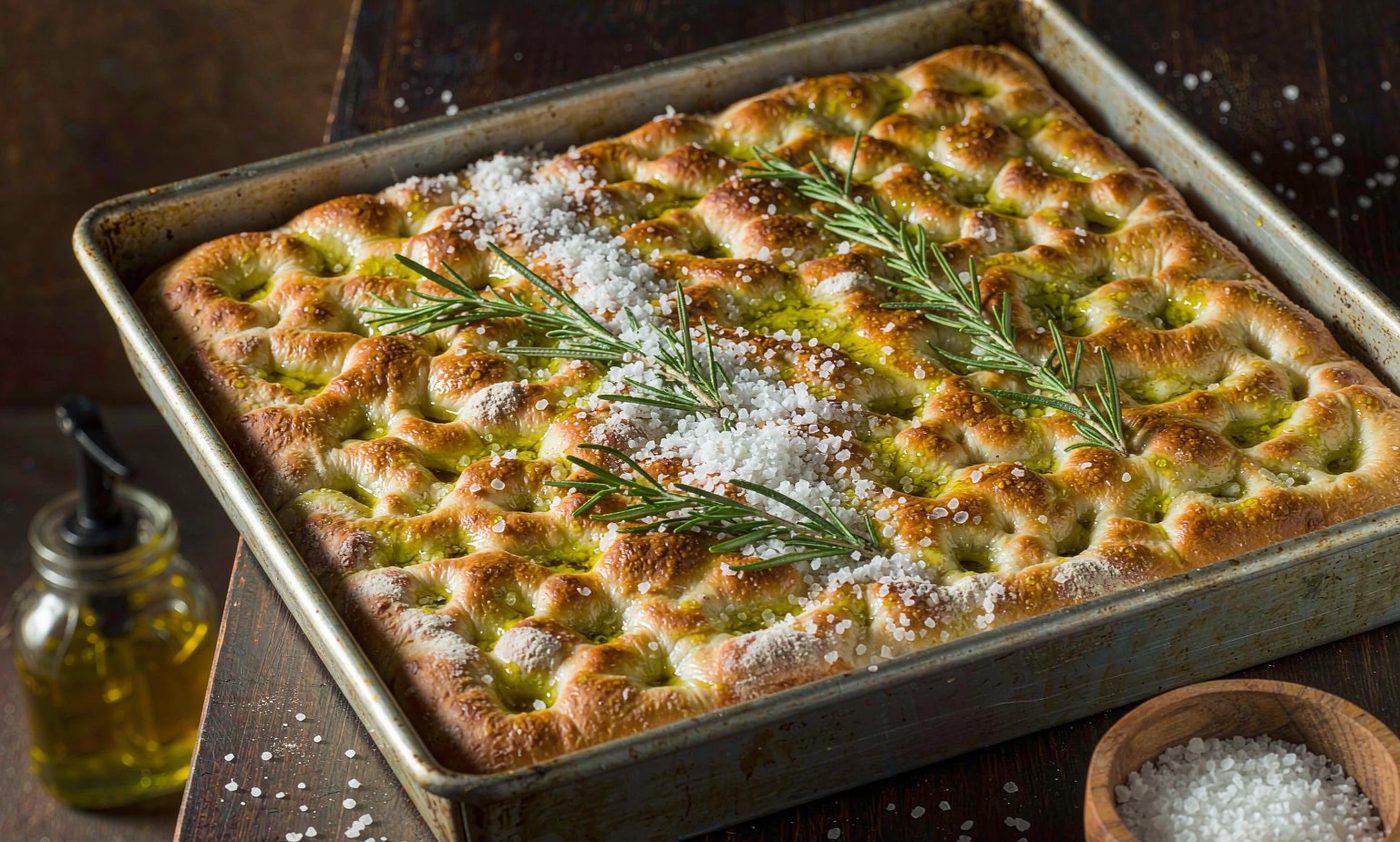
The one moment that matters is the dimpling. Oiled fingers, pressed all the way down to the base of the tray, not just denting the surface. Those depressions hold the olive oil and the rosemary, and they are what separates focaccia from flatbread.
Ingredients
Instructions
Put the flour, water, fine salt and yeast in a large bowl. Mix with a sturdy spoon for about a minute, until there are no dry patches left. The dough will be wet, shaggy and frankly unpromising. That is correct.
Cover the bowl with a plate or cling film and leave it at room temperature for 30 minutes, then put it in the fridge and leave it overnight, for 12 to 16 hours.
The next day, pour 3 tablespoons of the extra virgin olive oil into a 30 x 23 cm baking tray and use your hand to coat the base and sides thoroughly.
Scrape the cold dough into the tray. It will be slack and bubbly. Fold it over on itself twice with a wet hand, then turn it so the smooth side faces up. Let it relax for 20 minutes.
Gently stretch the dough towards the corners of the tray. It will resist — let it rest for 10 minutes and try again. Two or three rounds is normal. Cover and leave to prove at room temperature for 90 minutes to 2 hours, until visibly puffed and jiggly.
Heat the oven to 230°C fan. Oil your fingers generously and press them right down through the dough to the base of the tray, at intervals of about 4 cm, making deep pools. Drizzle over the remaining olive oil and scatter with rosemary and flaky salt.
Bake for 20 to 24 minutes, until the top is a deep golden brown and the base sounds hollow when you lift a corner with a palette knife. If it is colouring too quickly, cover loosely with foil for the last five minutes.
Slide the focaccia onto a wire rack straight away and let it cool for at least 15 minutes. This is the hardest instruction in the recipe.
Testing notes & substitutions
Use cold water and a cold fridge
Warm water speeds the ferment up, which is the opposite of what you want over twelve hours. Cold water gives you a slower, more flavourful rise and a much bigger margin for error.
The tray size matters
A larger tray gives you a thinner, crisper focaccia; a smaller one gives you a taller, softer one. Both are good. Do not use a tray smaller than 28 x 20 cm or the dough will overflow.
Under-proved or over-proved?
Under-proved dough springs back hard when you dimple it and bakes up tight. Over-proved dough collapses and looks deflated. You are looking for jiggly but still domed.
Questions we get a lot
Can I use a stand mixer?
You can, with a dough hook for three minutes, but it is genuinely unnecessary. A spoon and a bowl is all this needs, and the overnight rest does the development work.
Can I make it on the same day?
Yes — leave it at room temperature for four hours instead of overnight. It will be perfectly good, just noticeably less complex.
Why is my focaccia flat?
Usually the yeast was old, or the dough never came back to room temperature before baking. Cold dough does not rise in the oven the way warm dough does.
Dana Reyes
Dana has cooked professionally for eleven years and has been testing recipes for Hearth & Thyme since 2019. She writes about weeknight cooking, slow breads, and the small techniques that quietly change a dish. Every recipe she publishes is cooked at least twice, in an ordinary home oven.
Keep cooking
More baking & breads
Everyday Sourdough Boule
Butter Skillet Cornbread