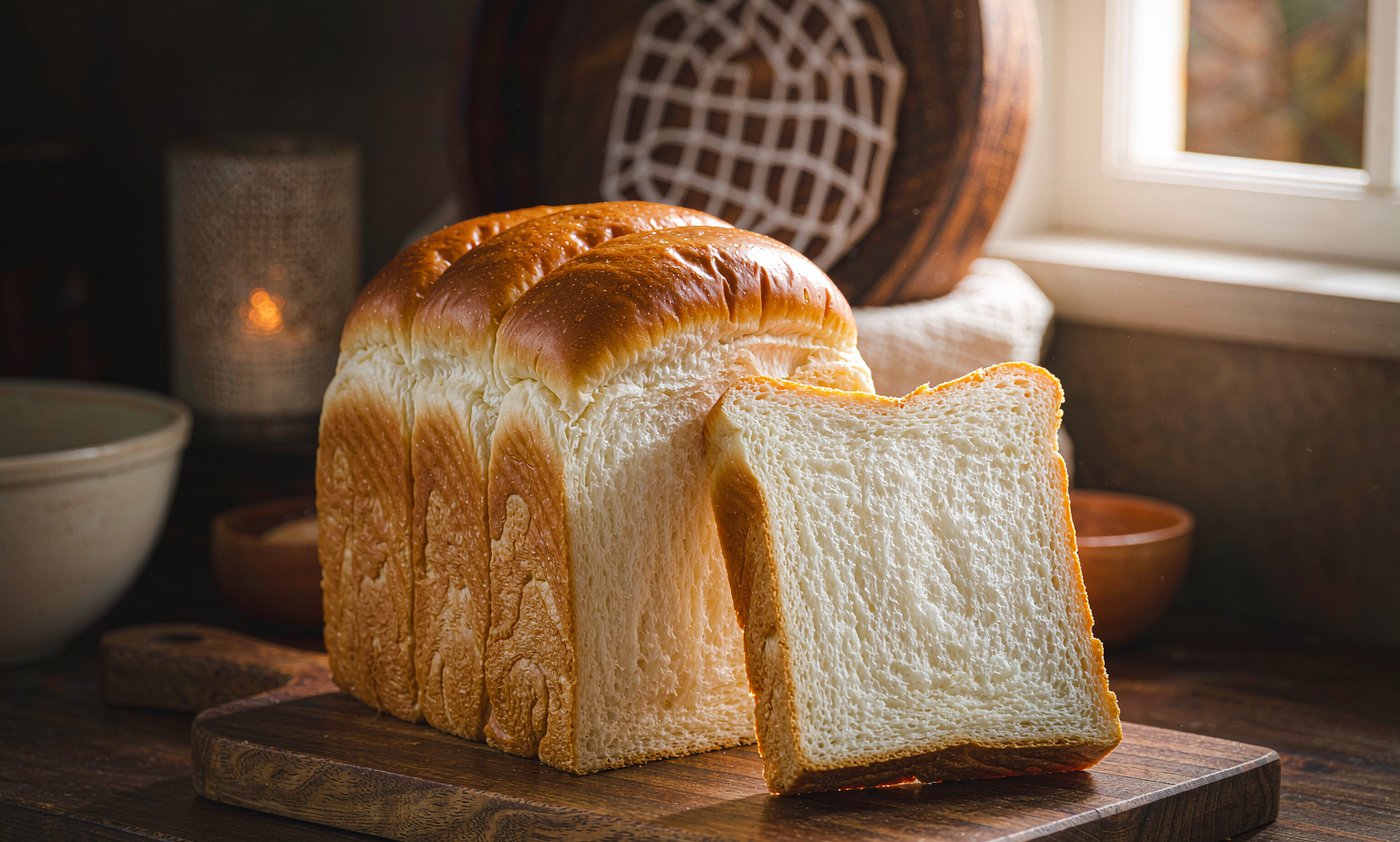
Shokupan Milk Bread Loaf
Tangzhong is a paste of flour and water cooked until it gelatinises, and it is the whole secret behind Japanese milk bread.
One small step, one very soft loaf
Tangzhong is a paste of flour and water cooked until it gelatinises, and it is the whole secret behind Japanese milk bread. Because the starch is already hydrated and set, it traps water in the crumb and holds it there. The loaf comes out softer, tears into feathery strands, and is still good four days later.
It costs ninety seconds. You cook 20 g of flour with 100 g of water in a small pan, stirring, until it thickens and leaves a visible trail behind the spoon. Cool it and add it with everything else.
The rest is an enriched dough — milk, butter, sugar — which is slow to develop and likes to be kneaded further than you think. Push it until it will stretch into a thin, translucent window without tearing.
Ingredients
Instructions
Make the tangzhong: whisk the flour and water in a small pan until smooth, then cook over medium heat, stirring constantly, for about 90 seconds until it thickens into a paste. Scrape it onto a plate, cover and cool completely.
In a large bowl or mixer, combine the bread flour, yeast, sugar, salt, egg, milk and the cooled tangzhong. Mix to a shaggy dough and rest for 20 minutes.
Knead for 8 to 10 minutes by machine, or 15 by hand, until the dough is smooth. Then add the soft butter a tablespoon at a time, incorporating each piece fully before the next.
Keep kneading for a further 8 to 10 minutes. The dough will look greasy and broken in the middle of this and then come together suddenly. It is ready when it stretches into a thin translucent window.
Cover and prove for 90 minutes to 2 hours, until doubled.
Divide the dough into three equal pieces. Roll each into a rectangle about 20 x 30 cm, fold the long sides in to the centre, then roll up tightly from one short end into a cylinder.
Place the three rolls seam-side down in a greased 450 g loaf tin, side by side. Cover and prove for 60 to 75 minutes, until the dough has risen above the rim of the tin.
Heat the oven to 180°C fan. Brush the top very gently with milk, taking care not to deflate it.
Bake for 32 to 36 minutes, until deep golden and hollow-sounding. If the top darkens past 20 minutes, lay a piece of foil loosely over it.
Turn out onto a rack and cool for at least an hour. Slicing it warm compresses the crumb.
Testing notes & substitutions
Do not skip cooling the tangzhong
Adding it warm will kill the yeast or overheat the dough. Spread it on a plate rather than leaving it in the pan, and it will cool in about ten minutes.
Soft butter, not melted
Melted butter does not emulsify into the dough and gives you a greasier crumb. Leave it out for an hour or soften it in short bursts in the microwave.
The windowpane test is not optional
Enriched doughs need more development than lean ones. If it tears instead of stretching thin, keep going — this loaf is forgiving of extra kneading and unforgiving of too little.
Questions we get a lot
Can I make it without a stand mixer?
Yes, but expect fifteen minutes of hand kneading and a sticky start. A light oiling on your hands helps. It is a genuinely good workout.
Why did my loaf collapse?
Almost always over-proofing at the final stage. If the dough has more than doubled or looks fragile when you nudge it, bake it immediately rather than waiting.
How long does it keep?
Four days in a paper bag or a bread box, which is unusually long. Do not refrigerate it — that makes bread stale faster, not slower.
Dana Reyes
Dana has cooked professionally for eleven years and has been testing recipes for Hearth & Thyme since 2019. She writes about weeknight cooking, slow breads, and the small techniques that quietly change a dish. Every recipe she publishes is cooked at least twice, in an ordinary home oven.
Keep cooking
More baking & breads
Overnight No-Knead Focaccia
Everyday Sourdough Boule